
Tomb of the Unknown Soldier in Bucharest’s Carol Park
The Tomb of the Unknown Soldier (Mormântul Ostașului Necunoscut) is a memorial in Carol Park in Bucharest, Romania, dedicated to the soldiers who died in the First World War. It is a quiet place of remembrance, and its story, from a boy’s choice in 1923 to a secret night-time move under communism, is worth knowing before you visit.
One of ten unnamed soldiers was chosen by a twelve-year-old war orphan, who knelt before a coffin and said, “This is my father.” In 1958 the tomb was moved away overnight.
The history of the Tomb of the Unknown Soldier
In 1923, a few years after the First World War, Romania decided to honour its fallen with one man who would stand for all of them. A war orphan from a military school was to choose the coffin, and from four candidates the choice fell on Amilcar Săndulescu, a twelve-year-old pupil of the Dimitrie Sturdza Military High School in Craiova, whose father had died at the front in 1917.
The remains of ten unidentified soldiers, exhumed from battlefields and graves in places such as Mărășești, Mărăști, Oituz, Târgu Ocna, Bucharest, Dobruja, Transylvania and Bessarabia, were placed in oak coffins lined with zinc in the Church of the Assumption at Mărășești. At a solemn ceremony in mid-May 1923 the boy knelt in front of the fourth coffin and said, “This is my father.” The other nine soldiers were buried with military honours in the Heroes’ Cemetery at Mărășești.
The chosen coffin, wrapped in the Romanian tricolour, travelled to Bucharest by special train, where King Ferdinand and an honour guard waited. Carried on a gun carriage drawn by eight horses, it lay for two days in the Mihai Vodă Church so that people could pay their respects. On 17 May 1923, Heroes’ Day, it was buried in a crypt in Carol Park in the presence of the royal family, the government, members of parliament and a large crowd. In June 1923 the United States War Department announced that the Medal of Honor would be awarded to the Romanian Unknown Soldier, one of only five such awards to the unknown soldiers of allied nations.
The monument, linked to the sculptor Emil Wilhelm Becker, stood in front of the Palace of the Arts, then home to the Military Museum, and became a national place of pilgrimage for the roughly 225,000 soldiers who gave their lives in the war. In the night of 22 to 23 December 1958 the communist regime secretly dismantled it and moved it to the Mărășești Mausoleum, to make room for a mausoleum of communist heroes, where leaders such as Gheorghe Gheorghiu-Dej were later buried. After the fall of the regime the tomb came back to Carol Park in 1991, first to a provisional spot, and in the 2000s it was returned to the esplanade of its original site. It is now a listed historic monument of the highest category.
Curiosities about the Tomb of the Unknown Soldier
- The soldier was chosen by a child: Amilcar Săndulescu, aged twelve and himself a war orphan, stopped at the fourth of ten coffins and said it held his father.
- Ten coffins were prepared at Mărășești, but only one went to Bucharest. The other nine were buried with military honours in the Heroes’ Cemetery there.
- On the day of the burial the whole country was invited to stop work and observe two minutes of silence.
- The slab of the first crypt spoke of a soldier who gave his life for the unity of the Romanian people and ended with the dates 1916–1919.
- The United States awarded its Medal of Honor to the Romanian Unknown Soldier in 1923, one of only five given to unknown soldiers of allied nations.
- In December 1958 the tomb was removed in secret during one night, and it took until 1991 for it to return to Carol Park.
Tours near Tomb of the Unknown Soldier
Experiences in the area that you can book online with Viator:

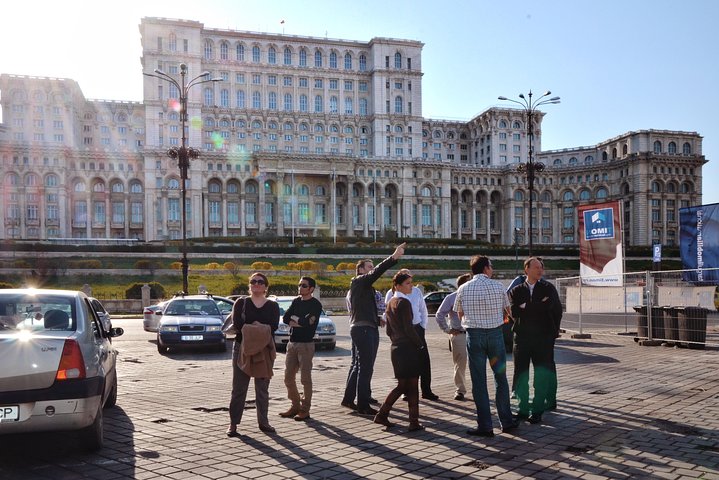


Visiting the Tomb of the Unknown Soldier in Carol Park
- The tomb stands on the esplanade in front of the Memorial of the Heroes of the Nation in Carol Park, Bucharest. It is a memorial, so a quiet and respectful visit suits it best.
- Photographs of the site show changing-of-the-guard ceremonies in the park; the sources give no schedule, so check the current arrangements before you go.
- Carol Park is also home to the former Palace of the Arts, which housed the Military Museum when the tomb was first set up.
- Antim Monastery, Radu Vodă Monastery and Stavropoleos Monastery are all about 2 km away, and Kretzulescu Church about 3 km, so the tomb combines easily with a walk through old Bucharest.
- Check the current opening hours and access arrangements before you go.
Opening hours, access and conditions can change. Check before you go.
Map: where Tomb of the Unknown Soldier is
Map: © OpenStreetMap contributors
Photos of Tomb of the Unknown Soldier

.jpg)


Questions
What is the Tomb of the Unknown Soldier in Bucharest?
It is a national memorial in Carol Park to the Romanian soldiers who died in the First World War. It holds the remains of one unidentified soldier who stands for all of them.
Who chose the Unknown Soldier?
A twelve-year-old war orphan, Amilcar Săndulescu, a pupil at a military high school in Craiova. He stopped at the fourth of ten coffins and said, “This is my father.”
Why was the tomb moved in 1958?
The communist authorities dismantled it in the night of 22 to 23 December 1958 and took the remains to the Mărășești Mausoleum, to make room for a mausoleum of communist heroes.
Is the tomb in its original place today?
Almost. It returned to Carol Park in 1991 at a provisional spot and in the 2000s was moved back to its original 1923 location, on the esplanade in front of the Memorial of the Heroes of the Nation.
Why did the United States honour the Romanian Unknown Soldier?
In June 1923 the US War Department announced the award of the Medal of Honor to him, one of only five such awards to the unknown soldiers of allied nations.
What can you see near the Tomb of the Unknown Soldier?
Antim, Radu Vodă and Stavropoleos monasteries lie about 2 km away, and Kretzulescu Church about 3 km.
Also nearby

Radu Vodă Monastery
Bucharest · monastery on a hill settled since prehistory
1.5 km away

Antim Monastery
Bucharest · 1715 monastery with carved stone and a snail emblem
1.5 km away

Stavropoleos Monastery
Bucharest · 1724 Brâncovenesc church and nuns’ monastery
2.5 km away

Kretzulescu Church
Bucharest · Brâncovenesc church by Revolution Square
3 km away