
Șimleu Silvaniei Fort: the Báthory family’s ruined castle
Șimleu Silvaniei Fort, also called Báthory Castle or Báthory Citadel, is a ruined medieval stronghold in the town of Șimleu Silvaniei, Sălaj County, north-western Romania. It was the ancestral seat of the Hungarian Báthory family, and what remains is worth a stop for anyone following the story of Transylvania’s princes.
The ancestral castle of a family that gave Transylvania several princes and Poland a king survives today only as a few towers and bastions in a quiet town in Sălaj.
The history of Șimleu Silvaniei Fort
The hills around Șimleu mattered long before any castle stood here. Before the Roman conquest of Dacia, seven Dacian fortresses, some with settlements beside them, were arranged in an arc around the hills and watched over the salt road that led towards Pannonia. Much later, two treasure hoards found in 1797 and 1889, dating from the 4th and 5th centuries, point to the presence of East Germanic groups, probably Gepids. The area was a crossroads long before the Middle Ages.
The castle belongs to the Middle Ages and to the Báthory family, who made Șimleu their ancestral seat. The fortress is first mentioned in 1319, and the town itself appears in medieval records under the name Wathasomlyowa, said to mean “Wata’s mountain”. After the defeat at Mohács in 1526 the Kingdom of Hungary broke apart, and Șimleu became part of the Principality of Transylvania. It was a period in which members of the family rose very high: Stephen Báthory (1533–1586) became Prince of Transylvania, then King of Poland and Grand Duke of Lithuania, and his relative Christopher was voivode of Transylvania from 1576 to 1581.
The 1590s brought a change. In 1592 the Báthorys built a mansion in the town, and the old castle was left deserted. In 1600 the mansion was taken from Zsigmond Báthory by the imperial general Giorgio Basta. Andrew Báthory, a cardinal, was Prince of Transylvania in 1599, and Sophia Báthory, who died in 1680, is remembered as a notable member of the Șimleu branch of the family. Later the town suffered from Ottoman raids: it was occupied in 1660 and belonged to the Ottoman province of Varat until 1692, and in 1703 it was held by the Kuruc insurgents.
From the end of the 17th century the region came under Habsburg rule, and from 1876 to 1920 Șimleu belonged to Szilágy County in the Kingdom of Hungary. After 1920 it became part of Romania, with a brief return to Hungary between 1940 and 1944. The castle itself, abandoned for centuries, is today a ruin. What survives above ground are the towers on the eastern side of the first enclosure, the gate tower of the second enclosure and parts of the bastions, which still show the layout of a fortress built in several rings.
Curiosities about Șimleu Silvaniei Fort
- The town has several names: Șimleu Silvaniei in Romanian, Szilágysomlyó in Hungarian and Schomlenmarkt in German.
- Its medieval name, Wathasomlyowa, is said to mean “Wata’s mountain”, with Wata an Old Turkish personal name.
- Seven Dacian fortresses once ringed the hills of Șimleu to guard the salt road towards Pannonia.
- Two treasure hoards from the 4th and 5th centuries were found on the same plot of land in 1797 and 1889.
- Stephen Báthory (1533–1586), listed among the notable people of Șimleu, became both Prince of Transylvania and King of Poland.
- The castle appears under several names, including Báthory Castle, Báthory Fortress and Șimleu Silvaniei Fort, because it is described both as a castle and as a fort.
Tours near Șimleu Silvaniei Fort
Experiences in the area that you can book online with Viator:

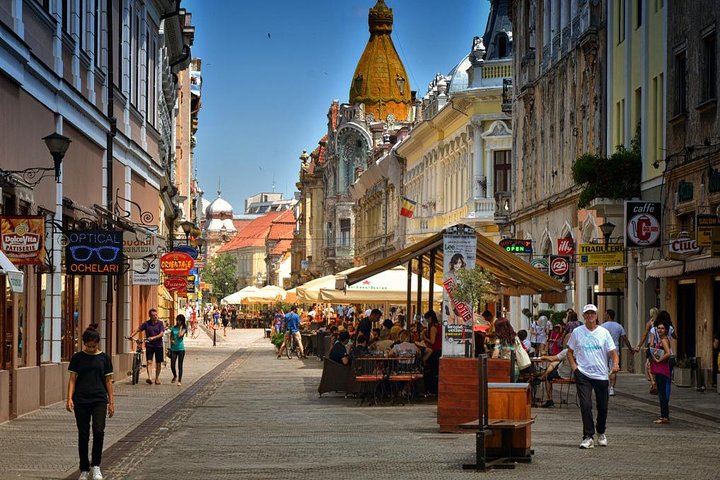


Visiting Șimleu Silvaniei Fort: what to see
- The ruins show the towers of the east side of the first enclosure, the gate tower of the second enclosure and parts of the bastions.
- In the town you can also see a 16th-century Báthory mansion and a Roman Catholic church from the same century.
- The old synagogue, built in 1876, now houses the Northern Transylvania Holocaust Memorial Museum, a sober place that tells the story of the local Jewish community.
- Just outside the centre, the nature reserve of Cehei Pond covers about 18 hectares, and Bic Monastery holds a wooden church from 1778.
- Access arrangements for the ruins are not described in the sources, so check the current opening hours before you go.
Opening hours, access and conditions can change. Check before you go.
Map: where Șimleu Silvaniei Fort is
Map: © OpenStreetMap contributors
Photos of Șimleu Silvaniei Fort


Questions
Where is Șimleu Silvaniei Fort?
It stands in the town of Șimleu Silvaniei in Sălaj County, in north-western Romania, in a valley of the western hills about 20 km west of Zalău.
Who built Șimleu Silvaniei Fort?
It was the ancestral castle of the Hungarian Báthory family. It is first mentioned in 1319, though the sources do not agree on every detail of its origin.
What is left of Báthory Castle today?
The castle is a ruin. The towers on the eastern side of the first enclosure, the gate tower of the second enclosure and parts of the bastions survive.
Why was the castle abandoned?
After the Báthory family built a mansion in the town in 1592, the old castle was left deserted and slowly fell into ruin.
Who were the Báthorys?
A Hungarian noble family that produced several rulers, including Stephen Báthory, Prince of Transylvania and King of Poland, and Andrew Báthory, Prince of Transylvania in 1599.
What else is there to see near Șimleu Silvaniei Fort?
In the town are the Báthory mansion, a Catholic church and the Holocaust memorial museum, and the Dacian-Roman site of Porolissum lies about 33 km away.
Also nearby

Porolissum
Sălaj · Roman forts, amphitheatre and a Dacian Limes site
33 km away

Stephen’s Tower
Baia Mare · medieval bell tower with city views
76 km away

Bonțida Bánffy Castle
Bonțida · Baroque “Versailles of Transylvania”
84 km away

Church of the Holy Archangels, Rogoz
Rogoz · UNESCO wooden church with 1785 murals
89 km away